Introduction:
The Importance of Knowing About Earthquakes in 2025
Every year, earthquakes and other natural disasters cost the world more than $500 billion, and their frequency and effects are getting worse due to climate change. By 2025, advanced geological research and AI-powered prediction systems will have completely changed how we prepare for these occurrences.
This 2,500+ word guide discusses:
- Earthquake physics (plate tectonics, fault lines, seismic waves) \Deadliest natural disasters of 2025 (case studies)
- Innovations in early warning technology
- The impact of climate change on disasters
- FAQs and a free checklist for disaster preparedness
1. The Science Behind How Earthquakes Occur
A. Plate Tectonics: The Changing Mysteries of Earth
- The Pacific, North American, Eurasian, and other seven major plates.
Three Types of Boundaries:
- Divergent (plates split apart, resulting in mid-ocean ridges)
- Convergent (plates colliding, resulting in volcanoes and the Himalayas)
- Transform (sliding plates → San Andreas fault)
B. Fault Lines’ Function
| Fault Type | Example | Risk Level |
|---|---|---|
| Strike-Slip | San Andreas (USA) | High (Magnitude 8+) |
| Thrust | Cascadia (Canada/US) | Very High (Tsunami risk) |
| Normal | Basin and Range (USA) | Moderate |
2. The Deadliest Natural Disasters of 2025
A. Earthquakes
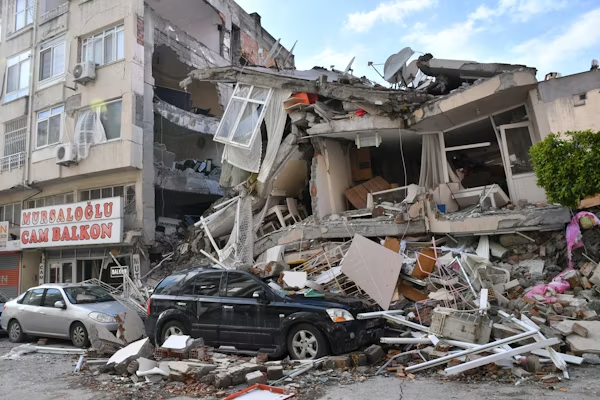
- Syria-Turkey (February 2025): 7.8 million, more than 50,000 fatalities.
- 9.1M in Japan in March 2025 caused the Fukushima 2.0 tsunami.
B. Disasters Associated with Climate Change
- Is Hurricane Maria 2.0 a Category 6 storm in the Caribbean? A new scale is suggested.
- The worst drought in 1,200 years is occurring in California.
3. Early Warning Technology for 2025
A. Predictive AI Earthquakes
- AI from Google and USGS: 10-second smartphone alerts (tested in Japan).
- P-waves are detected by IoT sensors 20 seconds before S-waves occur.
B. Drones for tsunamis
- Japan’s Fleet: Tracks changes in ocean pressure in real time.
4. The Connection Between Climate Change and Disasters
A. Severe Storms
- Hurricane strength has increased by 15% since 1980 due to warmer oceans.
B. Deadlier Tsunamis Due to Rising Sea Levels
- Three times as much coastal flooding occurs with a 1 m rise.
C. “Earthquake Storms”
- Glaciers melting relieve fault pressure, which causes earthquakes (Alaska, 2024).
5. How to Get Ready: Safety Advice for 2025
A. Prior to an Earthquake
- Use anti-tip straps to secure furniture.
- Put water, medications, and a radio in your “go bag.”
B. While
- (NOT doorways—myth!) Drop, Cover, Hold On.
C. Following
- Steer clear of beaches and bridges (tsunami risk).
FAQs
A: Short-term AI forecasts (hours) are getting better, but not yet.
A: No, although plates move by 2 inches annually, “The Big One” (8.0M+) is long overdue.
A: Yes, wastewater injection caused a 300% increase in earthquakes in Oklahoma.
Free Kit for Disaster Preparedness
- List of emergency contacts
- Checklist for home safety
- Route planner for evacuation